

Introduction
Do the driving modes in Cadillac LYRIQ offer different ranges or battery usages? Short answer: yes — but not in a way that’s usually expressed as a fixed “miles per mode” number. The LYRIQ’s selectable drive modes (Tour, Sport, Snow/Ice, and a customizable My Mode) alter throttle response, steering feel, suspension tuning (when equipped), and how aggressively the vehicle manages power and regenerative braking. Those changes change how much energy the vehicle uses, and therefore its real-world range, but Cadillac does not publish separate EPA range figures for each mode. Instead, drive modes shift the balance between performance and efficiency, so the measurable effect depends on how you drive and what other systems (like HVAC and one-pedal regen) are doing at the same time.
This article explains exactly how LYRIQ’s modes affect energy use, reviews what Cadillac documents and independent tests show, offers realistic estimates of potential range changes, and gives practical steps to measure and improve efficiency in everyday driving.
How LYRIQ’s driving modes work (and what they change)
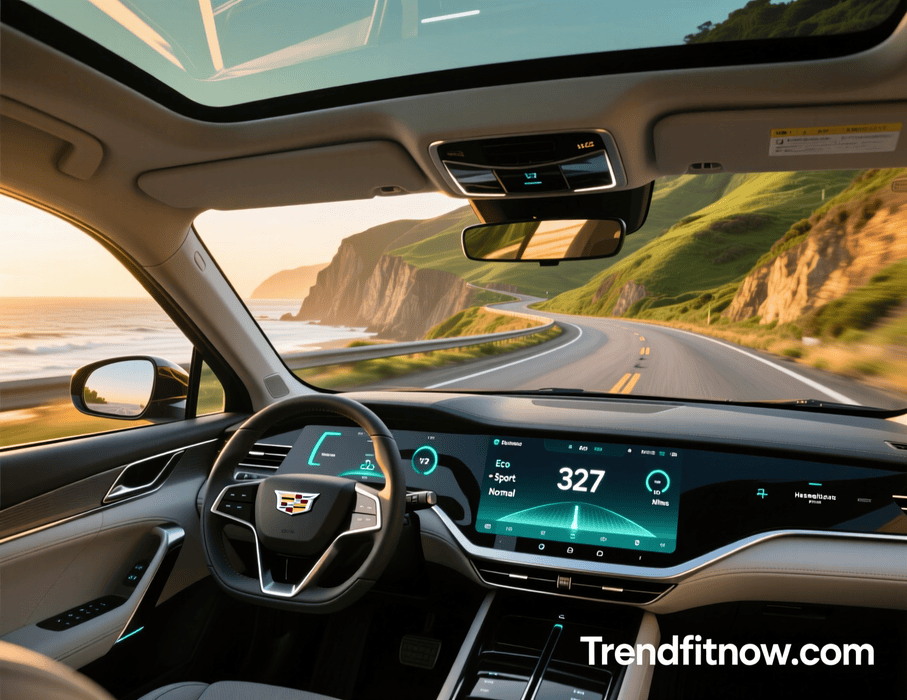
Cadillac’s official documentation describes Driver Mode Control and what each preset changes: Tour (everyday comfort/efficiency), Sport (more immediate throttle response and firmer steering), Snow/Ice (stability and traction prioritization), and My Mode (driver-customizable settings). These modes adjust the vehicle’s systems in small, specific ways:
- Throttle mapping: Sport sharpens pedal response (more immediate torque); Tour dampens it for smoother acceleration.
- Regenerative braking behavior and brake blending: One-Pedal Driving and Regen-on-Demand settings interact with drive modes; some mode combinations encourage stronger regen behavior that recovers energy during deceleration.
- Traction & stability tuning: Snow/Ice reduces torque delivery to prevent wheel spin, which can actually conserve or cost energy depending on slip and wheel spin corrections.
- Steering and suspension calibration: Sport may stiffen steering/suspension where adaptive dampers are equipped, increasing rolling losses slightly under some conditions.
None of these changes directly alter the LYRIQ’s battery chemistry or maximum usable kilowatt-hours — they only change how that stored energy is delivered and recovered. That’s why the effect on range is behavioral and conditional, not a fixed subtraction or addition to the official EPA figure.
What Cadillac and the owner manual say about modes and efficiency
Cadillac explicitly notes that Tour/Normal is intended for everyday driving and “optimizes fuel economy and drive quality,”. While Sport increases responsiveness and Snow/Ice helps prevent wheel spin. The LYRIQ owner manual and quick start guides describe One-Pedal Driving and the Regen-on-Demand paddle as tools to capture kinetic energy back into the battery, a primary lever for improving efficiency regardless of mode. Cadillac does not publish separate EPA ranges for each mode; official range figures are given per trim (RWD vs AWD, battery option) and conditions.
Because Cadillac’s published range numbers (for example, 326 mi RWD EPA estimate on newer model years) are measured under standardized EPA testing procedures, they reflect a baseline independent of driver-selectable tune settings. Real-world range, however, will vary with driving style, mode selection, speed, temperature, and accessory use.
Do driving modes change battery usage in measurable terms?
Yes — but the magnitude depends on use:
- Aggressive Sport driving: Sharper throttle mapping prompts higher acceleration events. Frequent heavy acceleration increases instantaneous power draw and therefore consumes more kWh per mile. Expect a measurable degradation in miles/kWh if Sport mode leads to repeated hard accelerations. Independent reviewers note that Sport sacrifices some range for responsiveness.
- Tour / Eco-oriented driving: Smoother throttle and gentler acceleration preserve energy and usually yield the best miles/kWh. Tour mode is calibrated to favor this balance.
- Snow/Ice: If the vehicle prevents wheel spin via torque limiting, energy may be conserved relative to spinning wheels. But if traction control interventions or more frequent use of friction brakes occur, efficiency can drop. Real impact varies with conditions.
- My Mode: If you program My Mode for aggressive acceleration and minimal regen, you’ll see reduced efficiency. If you program it for mild throttle and strong regen, you can approach Tour-level or slightly better efficiency.
Two other big levers are outside drive modes but interact with them: regenerative braking settings (One-Pedal Driving, Regen on Demand) and HVAC/climate usage. Strong regen and conservative climate settings can offset the extra energy Sport mode might otherwise consume. Cadillac’s documentation shows how to change regen levels and indicates that One-Pedal Driving can increase recuperated energy when used properly.
How much range can modes really change? Real-world evidence
You will not find an official Cadillac table that says “Sport = X fewer miles than Tour.” Instead, real-world testers and owner communities provide the best practical evidence:
- Independent reviews and road tests state that Tour yields the best real-world range in typical driving. While Sport reduces range because of more aggressive throttle mapping. For example, road coverage by Clean Fleet Report states Tour ‘will get the best range, Sport is when a bit more oomph is wanted.” That aligns with general EV efficiency principles.
- Independent range tests (e.g., long highway runs) show that speed, temperature, and aerodynamics dominate range outcomes. A LYRIQ driven at sustained highway speeds will lose range compared with mixed city driving, regardless of mode. But aggressive mode selection exacerbates the loss. Reviewers running EPA-style or real-world loops (70 vs 80 mph) show large range differences caused mainly by speed, not mode alone. Expect mode-driven changes to be single-digit to low-double-digit percent effects in most real driving, not hundreds of miles.
Put another way: if you normally get 3.0 mi/kWh in Tour under mild driving, switching to Sport with repeated hard accelerations might reduce that to 2.6–2.8 mi/kWh on the same route — a 5–13% penalty in efficiency. That translates to the same percentage change in range from the same battery state of charge. The exact numbers depend on driver behavior and conditions and are best validated by controlled testing for your driving profile. (Note: those example percentages are illustrative based on general EV behavior and independent commentary, not Cadillac’s official figures.)
How to measure the effect of modes on your LYRIQ — a simple test
If you want to quantify how the driving modes in Cadillac LYRIQ affect range and battery usage for your real-world habits, follow this practical test:
- Charge to a consistent state (e.g., 90% SOC) and set climate to a fixed setting (e.g., 72°F auto).
- Choose a repeatable route with mixed conditions (or a closed loop with minimal stops). Use the same start time to minimize temperature differences.
- Drive the route in Tour mode using a consistent, conservative throttle; record miles driven and kWh used from the instrument cluster or trip log.
- Fully recharge to the same SOC, then repeat the same route in Sport mode, keeping everything else identical (speed where safe, HVAC settings, regen setting).
- Compare miles/kWh and estimated range at identical SOC. Repeat the loop several times to smooth variability.
Document results and average multiple runs. You’ll get a numerically meaningful picture of the range tradeoff for your driving style. Online owner threads suggest small but measurable differences; this is the only way to know your exact outcome. Do the driving modes in Cadillac Lyriq offer different ranges or battery usages?
Practical tips to maximize LYRIQ range (regardless of mode)
Whether you choose Tour, Sport, or My Mode, these steps have larger effects on battery usage and range than mode alone:
- Favor one-pedal driving and stronger regen when traffic and terrain permit — this recovers energy back to the battery. Cadillac explains how to toggle One-Pedal Driving and use Regen-on-Demand.
- Keep highway speeds moderate, aerodynamic losses grow with the square of speed and dominate energy use at highway pace. Independent range tests show speed is often the biggest factor.
- Precondition the battery and cabin while plugged in in cold weather to reduce on-route HVAC draw. Cold temperatures reduce battery efficiency and usable range.
- Use cruise control or adaptive cruise where legal; steady speed is more efficient than oscillating throttle inputs. Edmunds and Consumer Reports use steady conditions to test realistic EV ranges.
- Minimize heavy cargo and roof racks — extra weight and drag cost energy.
- Monitor tire pressure — low pressure increases rolling resistance and energy use.
- Use Tour for everyday driving if range is a priority — Tour is tuned to favor efficiency.
Even a carefully chosen drive mode cannot overcome the physics of speed, weather, and accessory loads. Those are the main drivers of real-world battery usage.
When Sport (or other non-Tour) modes make sense
Choosing Sport, Snow/Ice, or a specific My Mode setting makes sense when safety or driver preference outweighs marginal efficiency losses:
- Sport: better when merging, overtaking, or on twisty roads, where responsiveness improves safety and confidence.
- Snow/Ice: essential in slippery conditions, it helps maintain traction and control, even if efficiency is marginally reduced.
- My Mode: useful if you want a specific balance (for example, firm steering but modest throttle). You can configure it to keep efficiency reasonable.
Use the appropriate mode for conditions; the minor range tradeoff is usually worth improved safety or control.
Bottom line — straight answer to the question
Do the driving modes in Cadillac LYRIQ offer different ranges or battery usages? Yes: the driving modes change the LYRIQ’s throttle mapping, steering/suspension calibrations, and (indirectly) how regenerative braking is used, all of which affect energy consumption and therefore real-world range. However, Cadillac does not provide separate EPA range numbers per mode; the measurable effect is conditional and depends heavily on driver behavior, speed, terrain, climate settings, and regenerative braking settings. For most drivers, the difference will be measurable but modest, typically in the single- to low-double-digit percent range when mode causes changes in acceleration behavior, and can be minimized by adopting efficient driving practices (one-pedal regen, moderate speeds, and Tour mode for range-sensitive trips).
You Might Also Read: https://trendfitnow.com/whosvalora-new-social-platform-guide/
