

Introduction
In today’s commercial aviation, unplanned diversions are still very rare events – they happen in less than 0.1% of long-haul flights worldwide – but they certainly open up a mighty window showing how airlines and aviation regulators keep the safety standards so high in 2025. The diverted flight of United Airlines Flight UA770 on July 22, 2025, immediately became a topic of public conversation, not because of the threat to passenger safety, but because such incidents disclose the operational rigor that is invisible to most travelers and is actually what makes global air travel one of the safest modes of transport. United Airlines flight UA770 emergency diversion
This piece of writing reveals the expert in detail the bold flight united airlines flight ua770 emergency diversion, analyzing the first response of the flight crew, the coordination efforts of the airports, and the reasons that make the Dreamliner one of the most reliable aircraft for the situations of long-route contingencies. You will find here the authoritative evaluation, the behind-the-scenes operational context, and the correct aviation insights that are not accessible through the standard news reports.
What Is the United Airlines Flight UA770 Emergency Diversion?
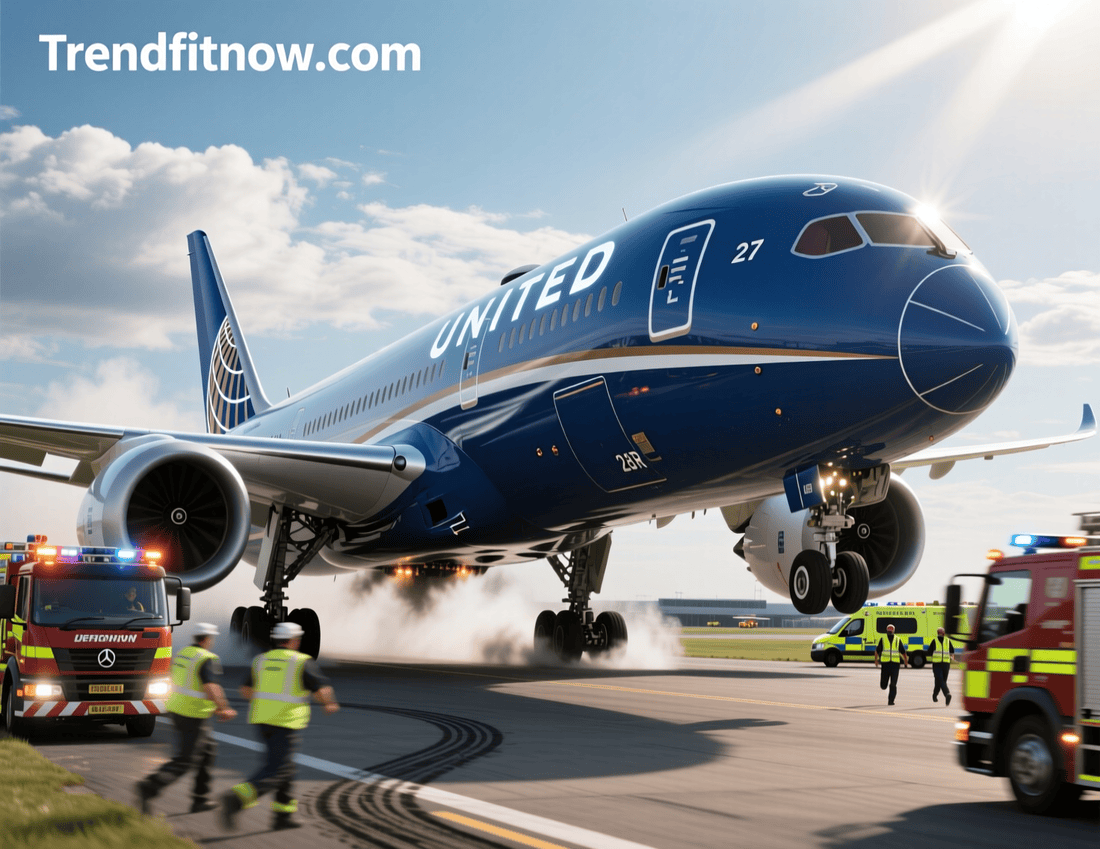
On July 22, 2025, the Boeing 787-9 Dreamliner of a scheduled United Airlines long-haul service from Barcelona (BCN) to Chicago O’Hare (ORD) called UA770, was forced to change its route and land in London Heathrow (LHR) after the crew discovered a technical irregularity in the middle of the cruise.
While modern aircraft experience occasional non-critical system alerts, long-haul operations follow strict “no-defer” safety principles. When a system behaves outside tolerance limits, crews initiate diversion procedures not because passengers are at imminent risk, but because predictive systems prioritize prevention.
How diversions function in global aviation:
Diversions are a coordinated chain of actions involving:
- Cockpit evaluation
- Communication with airline operations
- Communication with multiple ATC sectors
- Weather, runway, and service capability checks
- Airport readiness for unplanned arrivals
UA770 followed this globally standardized safety pathway.
Key Features & Critical Elements of the Incident
Core components of the diversion response
1. Detection of a technical malfunction
The Boeing 787-9 carries over 300,000 individual parameters monitored in real-time. Any abnormal reading in its integrated alerting system produces cockpit notifications that trigger a structured sequence of crew actions.
2. Boeing 787-9 alert architecture
The Dreamliner’s EICAS (Engine Indicating and Crew Alerting System) categorizes alerts into three levels:
- Advisory (non-critical)
- Caution (requires prompt crew action)
- Warning (requires immediate action)
Long-haul aircraft often divert on caution-level alerts when the safest long-term option is a nearby major hub.
3. Crew response protocols
Cockpit crews follow QRH (Quick Reference Handbook) checklists, digital and manual, which specify whether to continue, hold, or divert.
4. ATC communication
ATC coordination involves multiple sectors: Spanish controllers, French upper airspace, London Control, Heathrow Approach, and the airport’s operations center.
5. Why London Heathrow?
Heathrow is a designated diversion airport for several U.S. and European long-haul routes because:
- It handles heavy aircraft with full emergency services
- It has multiple long runways
- United Airlines has an operational presence and ground staff
- Technical support for Boeing 787 aircraft is readily available
Comparison Table
| Aspect | Standard Procedure | What Happened on UA770 |
|---|---|---|
| Alert Detection | Monitor cockpit systems; classify alert | Crew detected a system irregularity during cruise |
| Crew Action | Execute QRH checklist | Crew conducted checklist actions and evaluated options |
| ATC Contact | Declare intention; request vectors | UA770 coordinated with ATC for a safe reroute |
| Diversion Choice | Select nearest capable airport | Heathrow chosen for capability, support, and weather |
| Passenger Handling | Provide updates; maintain calm | Standard communication was provided on board |
Step-By-Step Breakdown of the Diversion Process
Step 1 – Cockpit Alerts & Initial Assessment
When the cockpit receives an alert, pilots perform:
- Identify alert category (Advisory, Caution, Warning).
- Run checklist items per Boeing’s defined QRH flow.
- Determine aircraft capability for continuing vs. diverting.
- Consult United Operations Control via ACARS if time permits.
Dreamliner pilots also use real-time engine and systems monitoring sent to airline maintenance engineers, enabling data-driven decisions.
Step 2 – Communication With ATC
Once crew determine diversion is necessary:
- A PAN-PAN call (urgency but not distress) may be issued depending on procedures.
- The crew notifies the nearest ATC sector of the intent to divert.
- Controllers coordinate with multiple airspace boundaries to ensure a safe, uninterrupted path.
This multi-sector coordination is why long-haul diversions require exceptional planning even under calm conditions.
Step 3 – Diverting to Heathrow (Operational Criteria)
Selection factors include:
- Runway length: Heathrow’s runways accommodate fully loaded 787s.
- Weather conditions: Stable visibility and low winds improve the margin of safety.
- Emergency services readiness: LHR maintains a full-time, large-aircraft response capability.
- Maintenance support: Heathrow hosts certified Dreamliner technicians.
Most importantly, Heathrow minimizes the time between landing and a detailed aircraft inspection.
Step 4 – Passenger Management & Cabin Updates
Cabin crew roles:
- Stay coordinated with the cockpit via secure interphone.
- Make calm, fact-based announcements.
- Secure galley equipment and cabin items.
- Monitor passengers for stress or medical needs.
- Prepare the cabin for a standard landing unless otherwise briefed.
Unique expert insight:
Dreamliners reduce diversion stress more effectively than older aircraft due to:
- Improved cabin pressure and humidity
- Lower noise levels
- Updated passenger information systems
- More stable ride performance
These features reduce physiological stress during unexpected route changes.
Step 5 – Final Approach & Safe Landing
During approach:
- ATC provides priority routing into Heathrow.
- Fire and rescue units stand by as a precaution (standard for unplanned technical stops).
- Pilots follow a normal landing configuration unless the checklist specifies modifications.
After touchdown, the aircraft taxis to a remote stand or designated gate for technical evaluation.
Passenger Experience & Safety Impacts
Passengers generally feel:
- A brief period of uncertainty before announcements
- Slight changes in cabin movement as the aircraft descends earlier than planned
- Minor schedule disruptions
- Assurance from professional crew communication
Cabin crew focus heavily on communication, the strongest factor in maintaining calm during diversions.
Contrary to popular assumptions, diversions rarely indicate immediate danger; they reflect aviation’s “prevention first” philosophy.
Aftermath, Inspection & Operational Follow-Up
Once on the ground:
- United Airlines’ engineering team inspects affected systems using Boeing diagnostic tools.
- Fault isolation tests run to determine the cause.
- Maintenance records document findings for FAA/EASA compliance.
- Passenger care protocols activate, including:
- Meal vouchers
- Hotel arrangements if needed
- Rebooking on alternative flights
- Dedicated customer service desks
2025 Industry Context
IATA’s 2025 guidance emphasizes:
- Enhanced data monitoring for long-haul aircraft
- Faster maintenance data transfer post-diversion
- Stricter reporting of recurring system alerts
These updates ensure even routine diversions contribute to safety improvements.
Pros & Cons of Mid-Flight Diversions
| Aspect | Pros | Cons |
|---|---|---|
| Safety | Ensures maximum risk reduction | Leads to operational disruption |
| Maintenance | Allows immediate system checks | Requires aircraft repositioning |
| Passenger Care | Airline assistance begins quickly | Delays and missed connections |
| Crew Operations | Crew follow prescribed safety pathways | Crew duty hours may be exceeded |
Top Alternatives & Comparison
Alternative 1 – Similar Boeing 787 Diversion Case
Several airlines have diverted 787 aircraft after predictive monitoring detected early signs of system irregularities. These events typically end with routine technical inspections and return to service.
Alternative 2 – European ATC Diversion Example
Major European hubs frequently receive diverted long-haul flights due to weather, medical needs, or system alerts. Airports like Dublin, Frankfurt, and Heathrow are designed to accept long-haul reroutes with minimal disruption.
Alternative 3 – United Airlines Safety Response Case
United has a long history of proactive diversions, often triggered by strict adherence to QRH procedures, highlighting the airline’s conservative approach to risk management.
Mini Comparison Chart
| Incident Type | Typical Outcome | Relation to UA770 |
|---|---|---|
| Technical Alert on 787 | Precautionary landing | Matches pattern |
| European Diversion | Efficient ATC coordination | Similar routing efficiency |
| United Proactive Response | Preventive inspection | Reflects UA safety philosophy |
Expert Insights, Trends & Future Aviation Safety Outlook (2025–2030)
- Dreamliner safety tech is maturing:
Boeing’s predictive maintenance systems now identify irregularities earlier than previous aircraft generations. - Expect more preventive diversions:
As aircraft sensors grow more sensitive, airlines will increasingly divert proactively. - Training is intensifying:
Airlines incorporate scenario-based simulation focusing on cross-border diversions and multi-agency ATC coordination. - Regulators stress data transparency:
FAA and EASA push for near-real-time sharing of post-diversion data to detect industry-wide trends earlier.
FAQs
Q1: What caused the united airlines flight ua770 emergency diversion?
A: A technical irregularity triggered standard long-haul safety procedures, leading the crew to divert to Heathrow as a precaution.
Q2: Were passengers at risk?
A: No. Diversions are preventive measures designed to maintain maximum safety margins.
Q3: Why was Heathrow selected?
A: Heathrow offers long runways, full emergency services, Dreamliner maintenance capability, and United Airlines ground support.
Q4: What happens to the aircraft after diversion?
A: It undergoes detailed inspections and diagnostic testing before returning to service.
Q5: Do diversions affect crew duty hours?
A: Yes. Unplanned diversions often require crew changes depending on regulations.
Q6: Are Boeing 787-9s prone to diversions?
A: No. The 787’s predictive systems simply identify issues earlier, leading to more precautionary — not risk-based — diversions.
Conclusion
The incident of united airlines flight ua770 emergency diversion is a brilliant example of how safety in modern aviation is ensured through a comprehensive prevention program rather than by reaction. Such a situation as this would not have resulted in serious accidents if there were state-of-the-art monitoring systems, well-trained crew members following correct procedures, and top-class airport coordination. As a result, situations like this serve as proof that long-haul air travel is still very safe in 2025. The passengers may be somewhat inconvenienced, but the story behind each diversion is always that of a global safety network functioning perfectly as it was designed.
For More Visit: https://trendfitnow.com/
